The decision, with conditions
- Choose this route when
- Choose a cupboard, side table, or trolley only after a normal meal shows a specific need and the support offers usable top space without obstructing occupied chairs or its own access.
- Use the alternative when
- Use the nearby kitchen counter or a temporary movable surface when permanent dining storage would duplicate capacity or compromise the everyday room.
- Stop or change the plan when
- Stop adding furniture if its parked position blocks circulation, its top immediately becomes unrelated storage, or its doors cannot be used during the meal it is intended to support.
Compare the practical options
| Serving support | Useful when | Confirm before keeping it |
|---|---|---|
| Closed sideboard | Tableware needs storage as well as a landing top | Actual dishes fit and doors open during dinner |
| Small side table | A jug or waiting dish needs temporary room | It does not become general clutter storage |
| Movable trolley | Extra support is needed only for some gatherings | Parked position, turning space, and floor transitions work |
| No extra furniture | The nearby kitchen already supports serving | The complete occupied meal remains comfortable |
An empty dining room can still lack space
Minimalist dining rooms often reduce the scene to a table, chairs, and a pendant. That arrangement can be beautiful and entirely sufficient for some households. It becomes inconvenient when every meal requires a stack of serving dishes, water, linens, or work materials with nowhere to go. The missing piece is not necessarily more decoration. It may be a small practical landing surface outside the tabletop.
Identify the missing task before buying a sideboard. A nearby kitchen surface may already serve it; extra furniture is justified only when its usable benefit exceeds the space and care it adds.
Differentiate eating space from serving space
Place settings occupy one kind of area; shared dishes occupy another. Set the table for an ordinary meal with the actual bowls, plates, glasses, and food containers. Notice whether diners must keep moving items to reach their own plates. If that happens regularly, a larger table or a secondary surface may be worth considering.
Do not assume the biggest possible table is the best response. It can reduce circulation every day to solve a serving problem that a modest side surface would handle. Compare both options at full scale. The right arrangement depends on room proportions, number of diners, and whether food is plated in the kitchen or brought out for sharing.
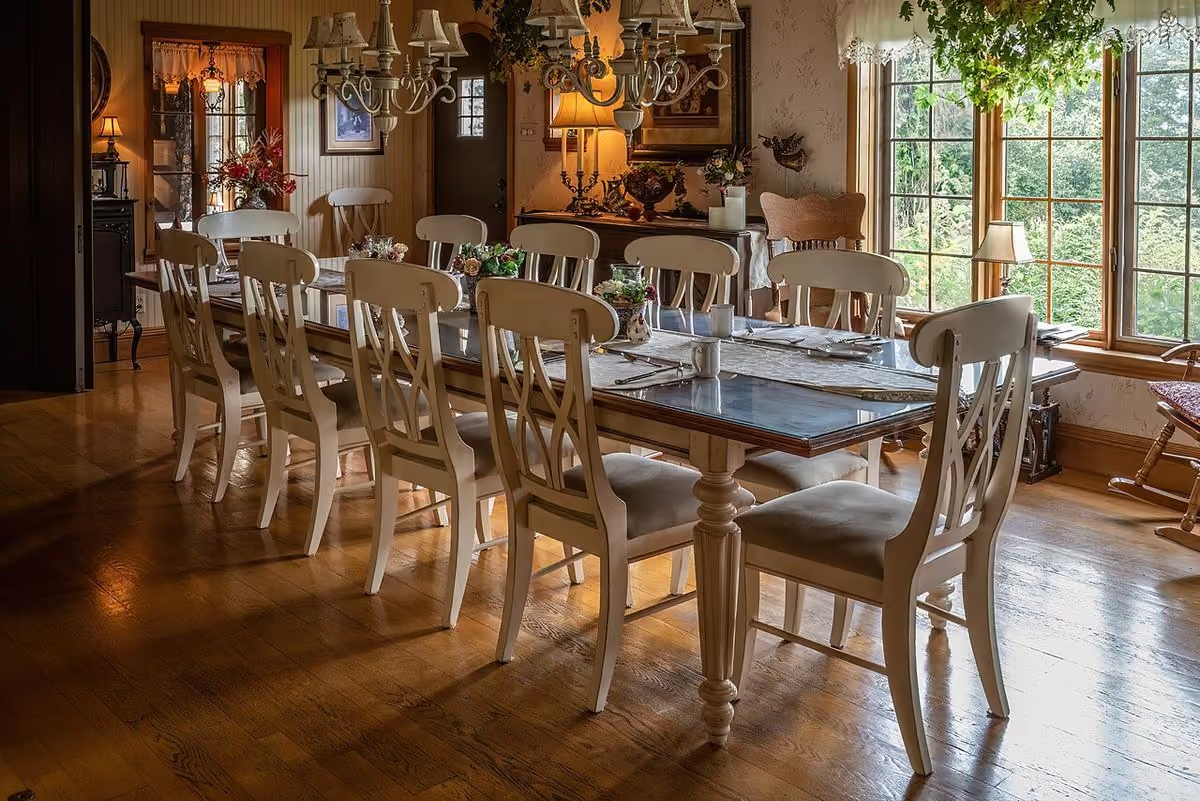
For a restrained scheme tested with shared dishes, compare A quiet dining room that still accommodates serving dishes.
Find the natural pause in the serving route
Trace the path from the kitchen to each seat. Look for a place where a dish can be set down without blocking the route or requiring a long reach. A surface close to the table may be useful, but not if its doors open into occupied chairs. Draw furniture in use rather than judging the empty plan.
If the room opens into a living area, keep the dining support from taking over the shared circulation. A low narrow unit might fit, while a deeper matching sideboard could be excessive. Measure the stored inventory before deciding depth. The most useful piece is the one that meets the task with the least conflict, not the one that completes a furniture range.
Compare three simple types of support
Compare a closed cupboard for stored tableware with a plain side table for short-term landing. Test the actual dishes and open doors before choosing by the room's furniture style.
A movable trolley can serve occasional gatherings and park elsewhere on ordinary days. Check its stability, wheel behavior, turning space, and the floor transitions along its route. It should not need to be squeezed into a corridor or block another activity when not in use. Flexibility has value only when the temporary and parked arrangements both work.
Give the surface a limited inventory
Decide what belongs there during a meal: perhaps water, a serving bowl, clean plates, or a small tray. Keep the rest elsewhere. A secondary surface can quickly become a general landing zone for mail, chargers, and decorative objects, leaving no room for its original purpose. A clear assignment makes the piece more useful than a vague promise of extra storage.
Inside a cupboard, group items according to the meal routine. Everyday linens should be easy to reach, while occasional platters can occupy a less convenient shelf if they remain safe to retrieve. Check the largest object before ordering. A shallow minimalist cabinet can look ideal and still fail to hold the very dish it was intended to store.
To keep a practical landing surface available between meals, see A Home with Beautiful Objects and Useful Empty Surfaces.
Make visual quiet through proportion
A plain cabinet in a related wall color can remain discreet without disappearing completely. A modest timber top may connect it to the table, while a different but compatible base prevents the room from looking like a matching suite. Keep the number of finishes limited and compare their actual sheen under the dining light.
The serving surface need not be perfectly centered on a wall if that position creates an awkward route. Balance is not the same as symmetry. A useful location can be visually resolved through its relationship to a light, artwork, or the table rather than by forcing it onto an architectural center line. The room should be composed around occupied life.
Plan light at both the meal and its support
The table pendant may leave a sideboard in shadow when dimmed. A small accessible lamp or another appropriate source can help the room retain depth and make serving easier. It need not become a second focal point. Test the light with the actual table setting and from seated positions to avoid glare.
If the support is movable, consider whether it needs its own light or can borrow from an existing source. Avoid running a cable across a route to preserve a decorative lamp position. Fixed electrical work requires proper installation. The simple room should remain understandable and safe when furniture moves for an occasional larger gathering.
Check care and reuse before committing
Serving surfaces encounter water, warm dishes, and frequent wiping. Read the finish instructions and identify any protection needed. A delicate top may be acceptable when its role is clear, but it should not require anxious handling throughout dinner. Keep protective mats nearby if they are part of the solution.
Ask how the piece could serve another room later. A freestanding cupboard or ordinary side table may be more adaptable than a highly fitted installation. Custom work can be justified by an unusual niche or specific inventory, but compare the full scope and replacement of hardware or tops. A minimalist room benefits from parts that remain useful when the household changes.
Test dinner before finalizing the room
Use a temporary table or existing cupboard to represent the support for several meals. Notice whether serving becomes easier, whether the top stays available, and whether the extra piece creates a new obstruction. If the benefit is small, remove it and compare again. Restraint includes deciding not to keep furniture that fails its test.
In an imagined supper, the tabletop remains generous because a jug and extra dishes have a convenient nearby home. The support is barely noticed, yet the meal feels less crowded. Confirm the meal footprint, serving route, occupied doors and chairs, inventory, light, care, and future use. The simplest dining room is the one that provides enough, in the right places, without demanding unnecessary movement.
Check, record, then decide.
A proposed worksheet for your own observations. Use consistent units for dimensions and keep the conditions with each record.
Meal versus table area
Where to check On the normal tabletop with everyday place settings, water, and shared dishes present.
- Record
- List what crowds a diner or needs moving, and distinguish food-serving space from work materials that should already have another home.
- Read the result
- The meal trial identifies a support need, not proof that the largest possible table or a matching sideboard is necessary.
- If it does not work
- Compare a small secondary surface with retaining the current table before increasing the permanent dining footprint.
Natural serving pause
Where to check Along the kitchen-to-table route, including the cupboard or trolley position during and after dinner.
- Record
- Draw occupied chairs, opened doors, turning points, and the parked support; measure relevant clear widths in centimeters.
- Read the result
- The sketch shows when an extra piece creates a new obstruction; it does not establish stability or load capacity of a trolley.
- If it does not work
- Use an existing kitchen landing area or move the support if its useful serving position has no workable parking place.
Available top and real inventory
Where to check On and inside the proposed support once its lamp, decor, plates, and linens are represented.
- Record
- Measure the largest stored dish and usable opening in centimeters; mark the top area that genuinely remains clear for meal use.
- Read the result
- A nominally large sideboard may add little serving space after permanent displays; the check does not rate its surface finish.
- If it does not work
- Reduce its assigned display or choose another support whose capacity and care fit the actual meal.
A practical trial
- Use an existing small table as a temporary serving support for several meals.
- Open storage with the nearest diner still seated.
- Remove the trial piece once and compare whether its benefit justifies its footprint.
Compare the same scope
- Closed cupboard, side table, trolley, or no addition
- Inventory and genuinely available serving top
- Mobility, finish protection, light, and later reuse
Cost drivers to discuss: Custom depths for large serving pieces; Suitable wheels and floor transitions; Lighting or wall work around a fixed support.
Choose another route when: Another dining piece is unnecessary when nearby kitchen support already works, or unsuitable when its doors and parked position compromise ordinary access.
The download is a blank record template. Your completed notes remain wherever you choose to keep them; this page has no measurement-submission service.
Sources for this guide
Each reference’s supported point and limits appear beside the relevant passage above. Product documentation applies to the named product, rather than every similar item or the photographed room.
Source text checked November 4, 2026. Specifications can change; confirm the current instructions for the exact item before ordering.
Your questions, considered.
Does a minimalist dining room need a sideboard?
No. Test the meal and existing kitchen support first. Add only the type and size of surface that resolves a real serving or storage problem.
Is a bigger table better than a serving trolley?
Not always. A larger table can reduce daily circulation; a trolley can help occasional meals if it has a workable route and parking position. Compare both occupied.
How do I stop a sideboard becoming cluttered?
Assign a limited meal-related inventory and preserve a clear landing area. Keep mail, chargers, and permanent displays from consuming the space intended for serving.
About this guide: written with AI assistance for TIANLICHUJU. These are general design ideas, not a measured survey or a completed client project. Any domestic vignette is fictional. Confirm product specifications, site dimensions and local requirements before construction; use qualified professionals for regulated work. Read our editorial approach or suggest a correction.