The decision, with conditions
- Choose this route when
- Choose removable current-project trays inside measured closed storage when both activities can start and stop without moving the other person's belongings or blocking the shared route.
- Use the alternative when
- Keep a defined active tray visible, or place one hobby at a separate work surface, when immediate reminders or partly assembled work make total concealment inconvenient.
- Stop or change the plan when
- Stop the cabinet purchase if the real equipment cannot fit through its opening or the activity requires dust, fumes, heat, or secure storage the room cannot accommodate.
Compare the practical options
| What needs a home | Useful arrangement | Check before buying |
|---|---|---|
| Current portable project | A tray that moves between seat and cabinet | The assembled project fits without repacking |
| Reserve supplies | Adjustable closed storage | Real boxes fit the internal shelf dimensions |
| Books, cup, and reading light | Reachable side surface beside the reader | Neither occupant must reach across the other |
| Sharp tools or unsuitable materials | Separate storage appropriate to the actual product | The living room is suitable for the activity |
Start with two routines, not one ideal image
A quiet room can become a source of tension when one person relaxes by reading and another relaxes by making things. A basket of yarn, model parts, or drawing tools is not necessarily clutter to its owner. Equally, a partner who finds an occupied surface distracting is not asking for a home without personality. The design problem is how to let both activities begin easily and end without an argument about tidying.
Use Japandi's restrained timber and background palette after agreeing what each person may leave active. The decisive detail is a convenient return path, not a requirement to hide either hobby.
Inventory the moments of starting and stopping
Lay out each current project beside its usual seat. Measure the container while the project remains usable, then distinguish that tray from reserve supplies needing less immediate access.
Distinguish active work from reserve supplies. The current project may need a fast landing place beside a chair. Extra wool, paper, or reference books can live farther away. That distinction avoids building a large display system around objects that are rarely touched. It also gives the visible surface a clear boundary: one active tray can remain out without every supply joining it.
For the internal-capacity and retrieval test behind that inventory, use Minimalist living storage that holds the actual inventory.
Make a low cabinet do two different jobs
A long closed cabinet can establish a quiet horizontal line while storing the less visually settled equipment. Choose its dimensions from the inventory rather than a reference photograph. Inside, removable trays let a task move to the chair in one trip. Adjustable shelves are useful when the hobby changes; highly fitted inserts can become obsolete after a single new purchase.
The top should have an assigned function. It might hold a reading lamp, a small ceramic object, and the current project tray. If it also becomes the route for mail, groceries, and charging devices, the original agreement will collapse. Give incoming objects another reachable landing place, preferably close to the entrance. Good storage reduces unnecessary journeys as well as visual noise.
Keep the seated experience personal
Do not choose identical chairs merely to make the room look composed. A reader may want a supported back and a side light; a maker may need a more upright seat and a surface at a different height. Use timber tone, fabric value, or a repeated curve to connect the seats without making them functionally identical.
Place a cup and the real hobby equipment beside each seat during a trial. Check whether a person can reach their belongings without leaning across a partner. A small movable table can be more valuable than a large central table that looks generous but is inconvenient from every chair. Protect the shared route so that someone can cross the room while an activity remains open.
When one seat is mainly for long reading sessions, compare A Reading Corner for Someone Who Reads for Hours.
Use texture to prevent sterility
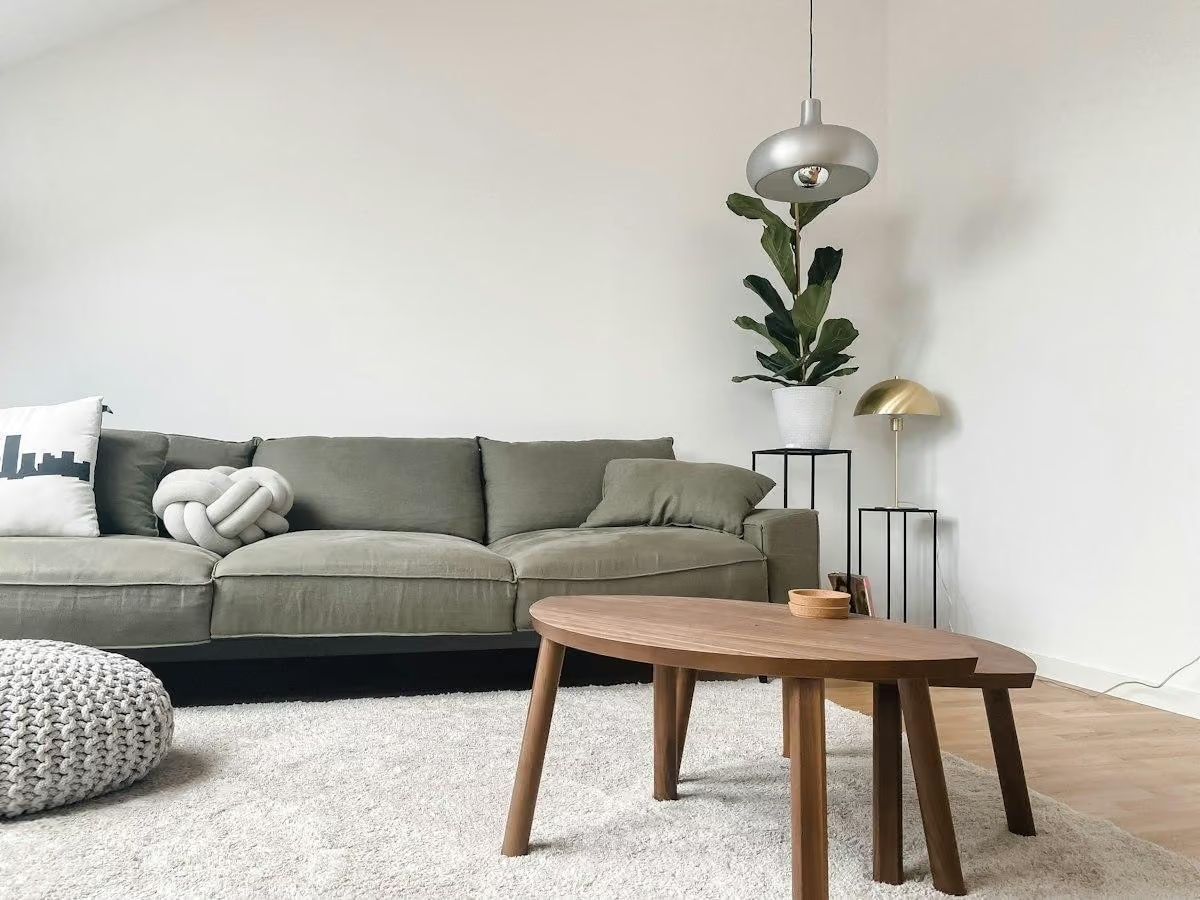
Pale oak, warm off-white, a little charcoal, and woven fabric can create a calm background without requiring a colorless home. Let one material contrast carry the detail: open wood grain beside tightly woven linen, for example. Avoid collecting several nearly identical beige finishes that do not quite agree. Samples should be compared together under the room's actual lamps.
A rug can define the seating group and soften the sound of tools or objects being put down. Its edge must remain outside the busiest turn, and its care instructions must fit the household. Delicate loose weaves may not suit small parts, needles, pets, or chairs that move frequently. The most suitable texture is one that can survive the activities it is meant to welcome.
Agree on a realistic night reset
The room does not need to become empty every evening. Agree instead on a state that makes the next morning comfortable: the walkway clear, drinks removed, tools safe, and unfinished work on its tray. A cabinet door should close without repacking the project like a puzzle. If it does not, either the internal space or the amount of active equipment needs revision.
Labels inside cupboards can help without adding visual detail to the room. So can one spare compartment for a changing interest. Resist filling every shelf immediately. Storage without breathing room often produces new overflow as soon as a birthday gift, book, or supply order arrives. A little unused capacity is practical, not wasteful.
Test before commissioning
Use an existing sideboard or boxes of the proposed dimensions for a week. Simulate the trays, the open top, and the reach from the chairs. Record the moments when someone avoids putting an item away because the action takes too long. Those moments reveal more than the tidy photograph at the end of the experiment.
Custom cabinetry may solve a difficult wall or a specific equipment size, but compare it with standard furniture plus simple internal trays. Ask about drawer loading, hinge access, finishing, and the removal of damaged parts. There is no universal cost advantage to either route. The useful comparison includes delivery, installation, adaptation, and how easily the cabinet could serve another purpose later.
Let quiet remain a shared benefit
In an explicitly imagined evening, one person reaches the end of a chapter while the other finishes a small repair. Neither has to stop because the room belongs to a single idea of relaxation. The lamp is useful, the table is reachable, and the unfinished task has a respectable place to rest.
That is the measure of this scheme. Before ordering, confirm the real equipment dimensions, both seated positions, the night reset, cleaning access, and the route through the room. If the calm depends on one occupant doing hidden work for the other, revise the arrangement. A restrained interior earns its warmth when it accommodates different ways of being at home.
Separate display from safe storage
Some hobbies involve sharp tools, small components, paints, or heat. Their storage should follow the actual product guidance and the needs of children or pets in the household. A beautiful open tray is not appropriate for every material. Decide which items may remain on a living-room surface and which require a secure separate location. Where a hobby produces fumes or dust, the living room may not be a suitable working area at all. The shared cabinet can still hold books and dry equipment without pretending to solve a ventilation or safety requirement.
Check, record, then decide.
A proposed worksheet for your own observations. Use consistent units for dimensions and keep the conditions with each record.
Active project volume
Where to check Beside each person's normal seat, with the current project left in its usable state.
- Record
- List the tools and pieces that must move together; measure their container's outside width, depth, and height in centimeters.
- Read the result
- This identifies a tray envelope, not the capacity required for all reserve supplies or permission to store hazardous materials here.
- If it does not work
- If the assembled project does not fit, give it a separate work location instead of requiring nightly dismantling.
Return sequence
Where to check Between the chosen chair and a box representing the cabinet's clear internal opening.
- Record
- For several evenings, note each lift, opened door, displaced object, and item left outside after the activity ends.
- Read the result
- Repeated avoidance suggests friction in access or grouping; it does not establish that either person's tidiness preference is wrong.
- If it does not work
- Change the tray, shelf position, or cabinet opening before adding more visible baskets around the seat.
Shared walking line
Where to check From the entrance past both occupied chairs to the next frequently used doorway.
- Record
- Sketch where feet, project trays, side tables, and opened cabinet doors enter the route; note the narrowest clear width in centimeters.
- Read the result
- The occupied sketch reveals local conflicts, not a universal clearance requirement or a formal accessibility assessment.
- If it does not work
- Move a side surface or shorten the cabinet; relocate activities that cannot coexist without obstructing ordinary movement.
A practical trial
- Load two real project trays before comparing cabinet interiors.
- Ask each person to return their equipment without instructions from the other.
- Repeat the route check while both hobbies are active, not after clearing the room.
Compare the same scope
- Clear internal openings and adjustable shelves
- Trays, hardware, delivery, and assembly
- Reachable tables and separate useful lamps
Cost drivers to discuss: Custom openings for unusually shaped equipment; Drawer mechanisms and internal fit-out; Cabinet access through the existing home.
Choose another route when: A shared living room is unsuitable for a hobby whose dust, fumes, heat, or secure-storage requirements cannot be addressed in that setting.
The download is a blank record template. Your completed notes remain wherever you choose to keep them; this page has no measurement-submission service.
Sources for this guide
Each reference’s supported point and limits appear beside the relevant passage above. Product documentation applies to the named product, rather than every similar item or the photographed room.
Source text checked November 4, 2026. Specifications can change; confirm the current instructions for the exact item before ordering.
Your questions, considered.
Must a Japandi living room hide every unfinished hobby?
No. A defined current-project tray can remain visible while reserve supplies stay in cupboards. Agree on a clear route, safe tools, and a realistic night reset.
How do we size a cabinet for two hobbies?
Measure the equipment during use and in its return containers. Separate active projects from reserve stock, then test those dimensions with boxes or existing furniture for a week.
Should both people use matching chairs?
Only if both chairs suit their activities and bodies. Related fabric or timber can connect an upright making seat and a more supported reading chair without identical shapes.
About this guide: written with AI assistance for TIANLICHUJU. These are general design ideas, not a measured survey or a completed client project. Any domestic vignette is fictional. Confirm product specifications, site dimensions and local requirements before construction; use qualified professionals for regulated work. Read our editorial approach or suggest a correction.