The decision, with conditions
- Choose this route when
- Choose the table when its exact construction, finish limits, and possible renewal suit the usual meals and the owner knowingly welcomes the kind of change it may show.
- Use the alternative when
- Use a more resistant specified finish or a smaller expressive object when the desired timber appearance would otherwise require constant warnings and vigilance at dinner.
- Stop or change the plan when
- Stop refinishing or daily use when the coating is uncertain, structural condition is unresolved, or the proposed treatment assumes sanding allowance that has not been established.
Compare the practical options
| Dining-table decision | What to clarify | How to make use easier |
|---|---|---|
| Timber and coating | The exact top construction and finish | Follow its actual care guidance rather than wood-species assumptions |
| Accepted visible marks | Owner response to an appropriate changed sample | Choose a different finish if the response is unwelcome |
| Coasters or heat pads | Protection required by the product | Store them close and leave serving space available |
| Future renewal | Whether refinishing or component repair is appropriate | Keep finish and restoration information |
A welcoming table should not make guests afraid of dinner
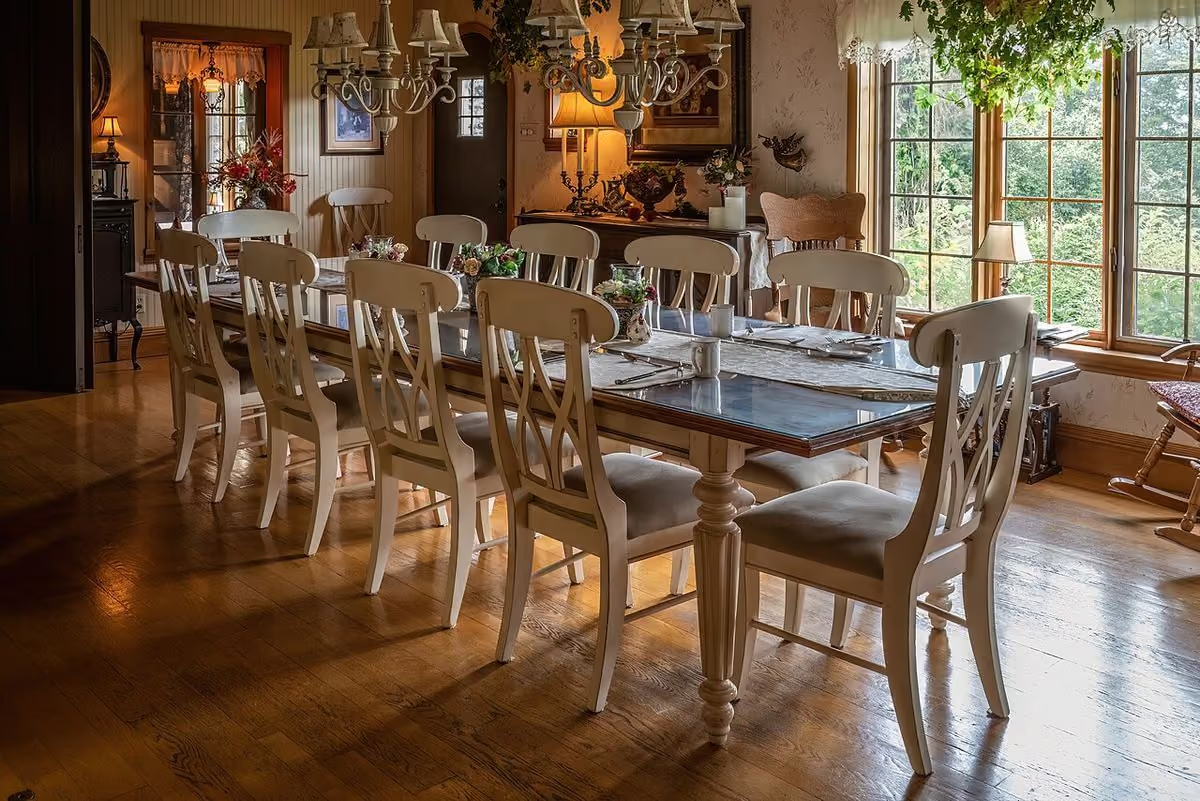
A dining table with visible grain, a softened edge, and a few marks of use can feel generous rather than precious. A wabi-sabi-inspired interpretation may value that changing surface, but hospitality still needs a clear practical agreement. Guests should not have to guess whether a glass, serving bowl, or warm dish might cause a problem. The owner should know what care the finish requires before the first meal begins.
Choose a surface that supports the way people eat. Accepted variation is personal; a table is not welcoming if normal drinks and serving dishes repeatedly create anxiety the owner did not intend.
Describe the usual meal
Think about breakfast cups, everyday dinners, shared serving dishes, and the occasional larger gathering. Does food arrive hot from the kitchen? Are drinks set down throughout the evening? Is the table also a work or craft surface? These tasks determine the finish requirements more usefully than a photograph of an empty timber top.
Include the care routine that actually happens. Some households happily use mats and wipe promptly; others prefer a surface that tolerates more casual handling. A table can suit either approach when it is specified accordingly. Problems arise when the design assumes careful behavior that nobody discussed. The furniture should support ordinary habits rather than depend on guests learning hidden rules.
Understand the finish, not just the wood species
Solid timber, veneer, and different coatings behave differently. Ask what the top is made from, how its edge is constructed, and which care instructions apply. A timber name cannot tell you whether the surface can be refinished or how it responds to heat and water. The finish and construction are part of the product's identity.
For a vintage table, the existing coating may be uncertain or altered by earlier work. Seek competent advice before applying oil, polish, or a new finish. A treatment that improves one surface may complicate another. If restoration is planned, define the intended use and desired tolerance for marks with the restorer rather than asking only for a more natural appearance.
Test an appropriate sample
Where a sample is available, ask the supplier what demonstrations or tests are permitted. View it under the dining room's light and compare it with plates, glasses, and the actual protective items the household is willing to use. A sample with an accepted mark can make the idea of patina tangible rather than abstract.
Do not assume a short test predicts every future condition. Its purpose is to support an informed choice and reveal expectations. If one occupant finds the changed surface unacceptable, reconsider before committing to a whole table. A different finish can preserve visible grain, while a smaller expressive object can carry the room's material irregularity without exposing the main meal surface to unwanted change.
Make protection convenient rather than ceremonial
If the finish requires coasters, mats, or heat pads, store them within easy reach and include them in the table arrangement. Protection should be convenient rather than a warning repeated to every guest.
Do not overload the table with a permanent display that leaves no place for those items or the food. A small central object can move to a nearby surface when dinner arrives. The table's main purpose should remain visible in its arrangement. A welcoming material can lose its generosity if every practical action requires clearing a delicate composition first.
For somewhere to keep protection and serving pieces within reach, compare A quiet dining room that still accommodates serving dishes.
Keep the touch points refined
Visible grain and irregular tone do not require a rough edge. Inspect the places touched by hands and forearms, as well as the underside near knees. A sound finish should suit the intended contact. Reclaimed material needs appropriate condition and prior-use assessment rather than an assumption that age makes it ready for a dining room.
The table must also be structurally dependable. Check stability, joints, and any extension mechanism according to its instructions. A worn top may be visually appealing, but an unstable base is a separate issue that needs attention. Do not preserve a failing connection for the sake of authenticity. Continued usefulness is a stronger reason to retain an old object than untouched damage.
When visible timber texture reaches the touch edge, examine Rustic living materials with smooth contact edges.
Balance irregularity with clear surroundings
A characterful top can sit within a simple room: comfortable chairs, a restrained wall, and a soft pendant. Avoid adding distressed finishes to every other piece. The table's variation will be easier to appreciate when the surrounding forms provide rest. A small dark ceramic or a plain woven textile may be sufficient supporting detail.
Consider the view under evening light. A strong directional source can emphasize surface marks and reflections, while another fitting may distribute light more gently. Test the finish sample beneath the intended pendant where possible. Keep faces visible and avoid solving an uncomfortable surface appearance by making the dining room too dim to use well.
Ask how the table will be renewed
Can the top be refinished, and by whom? Does the construction permit sanding, or would it risk a thin veneer? Can a damaged section or hardware component be replaced? These are product-specific questions. A general claim that timber is repairable is not enough to describe the table in front of you.
Keep the care instructions and restoration record. If the surface is intended to change, photograph it occasionally for practical reference rather than monitoring every mark anxiously. The aim is familiarity with its condition, not a new perfectionism about patina. Address problems that affect use and let accepted cosmetic changes remain part of the agreed material character.
Choose the surface that lets people relax
Compare purchase, restoration, delivery, protection, and future maintenance as a complete decision. An apparently inexpensive table may demand more work than expected, while a costly new finish may still have limitations. The best value is tied to the household's use and tolerance rather than the number of years or the marketing description.
In a fictional meal, a jug is set down confidently and conversation continues without a warning about every plate. The table feels lived with because its care is understood. Before buying, confirm the actual finish, meal routine, sample response, protection, smooth edges, structural condition, and renewal method. A table can welcome the marks of use most convincingly when it first welcomes the people making them.
Check, record, then decide.
A proposed worksheet for your own observations. Use consistent units for dimensions and keep the conditions with each record.
Meal-care mismatch
Where to check At the table with normal breakfast cups, shared serving dishes, and the protection the household is willing to use.
- Record
- List routine hot, wet, and work activities alongside the exact finish instructions; note where guests would otherwise need repeated warnings.
- Read the result
- The comparison identifies care friction, not a tested resistance to heat, liquid, or abrasion.
- If it does not work
- Choose a finish better suited to the meal rather than using an aesthetic idea to excuse unwanted daily anxiety.
Protection within reach
Where to check At each serving position and the nearby drawer or cupboard holding mats, coasters, and pads.
- Record
- Set a full familiar meal and note retrieval steps, lost tabletop area, and which practical items have no convenient return home.
- Read the result
- Convenient protection can support the routine but does not extend a product's limitations or authorize an unsuitable hot-dish placement.
- If it does not work
- Reassign storage or simplify the table display when the care plan only works by interrupting dinner.
Finish and renewal identity
Where to check At the top edge, underside, joints, and any vintage repair or uncertain coated area.
- Record
- Ask which parts are solid timber or veneer, identify the coating where possible, and record the proposed maintenance or restoration scope.
- Read the result
- A timber species name and a worn appearance do not establish sanding allowance, safe coating treatment, or structural soundness.
- If it does not work
- Obtain a condition-based assessment before refinishing, or choose another table if its required use exceeds the understood construction.
A practical trial
- Review an appropriate sample with the actual dining light and tableware.
- Inspect smooth hand and forearm edges separately from decorative grain.
- Ask how a damaged top or extension component can be renewed independently.
Compare the same scope
- Exact top construction and existing finish condition
- Protection, routine cleaning, and realistic accepted wear
- Restoration, delivery, extension parts, and later renewal
Cost drivers to discuss: Uncertain old coatings or veneer repairs; Specialized refinishing across a whole top; Transport and replacement extension components.
Choose another route when: A patina-led table is unsuitable when normal meals continually conflict with the finish or when the owner does not actually welcome its expected visible changes.
The download is a blank record template. Your completed notes remain wherever you choose to keep them; this page has no measurement-submission service.
Sources for this guide
Each reference’s supported point and limits appear beside the relevant passage above. Product documentation applies to the named product, rather than every similar item or the photographed room.
Source text checked November 4, 2026. Specifications can change; confirm the current instructions for the exact item before ordering.
Your questions, considered.
How do I choose a table that can age without causing anxiety?
Compare its specific finish limitations with normal meals and your tolerance for marks. Review permitted sample information before deciding that a changing surface is welcome.
Do guests need to know every table-care rule?
The room should make ordinary care convenient, with suitable protection nearby when needed. Avoid a surface whose routine limitations make the expected meal stressful.
Can any timber dining table be sanded later?
No. Construction, veneer thickness, existing coatings, and condition affect renewal. Ask about the actual table rather than assuming that a timber appearance guarantees refinishing.
About this guide: written with AI assistance for TIANLICHUJU. These are general design ideas, not a measured survey or a completed client project. Any domestic vignette is fictional. Confirm product specifications, site dimensions and local requirements before construction; use qualified professionals for regulated work. Read our editorial approach or suggest a correction.