The decision, with conditions
- Choose this route when
- Choose performance-focused window treatment when observation during the real sleep period identifies light leakage and a supplier can address the complete installation without compromising required operation.
- Use the alternative when
- If the principal disturbance is household or external noise, address its source and the arrival routine before spending the budget on darker-looking fabric.
- Stop or change the plan when
- Do not promise that blackout styling or a calming palette treats shift-work sleep difficulties. Persistent problems and work-related fatigue need appropriate health or occupational advice beyond this room plan.
Compare the practical options
| Daytime-sleep issue | Room or routine response | How to evaluate it |
|---|---|---|
| Light around the window treatment | Specify fabric, track, overlap and edge control together | Observe the actual morning or afternoon sleep period |
| Active household nearby | Adjust noisy routines and storage use | Discuss overlapping work and family schedules |
| Work equipment beside the pillow | Create a defined arrival landing place | Rehearse coming home tired with the normal bag |
| Room becomes uncomfortable when closed | Assess suitable ventilation and temperature arrangements | Do not block required vents to control light |
Plan for the time when sleep really happens
Use the shift worker’s actual sleep hours as the observation period. A bedroom that feels restful at night may receive direct light, deliveries or household activity during the day. Identify the dominant interruption before choosing decorative layers, and keep environmental improvements distinct from promises to treat persistent sleep or work-related fatigue problems.
This is an interior-planning discussion, not a treatment for a sleep disorder. If sleep problems persist, appropriate health advice belongs alongside practical changes to the room. The designer’s contribution is to remove avoidable environmental friction: unwanted light, awkward controls, visible work equipment and repeated household movement through the sleeping zone. Dark paint is not a complete strategy. A visually cocooning room can still have light leaking around the curtain, an inaccessible window handle and a bright charger facing the pillow.
Investigate light at the edges
Observe the room during the intended sleep hours rather than judging it after sunset. Mark direct patches of light separately from glow through the fabric and leakage around the installation. Ask the supplier which part of the proposed assembly addresses each entry point, including the operating method and the window’s required function. Compare that response with the noise record before assigning the budget. A darker textile is a poor first purchase if the dominant interruption is a delivery bell or another household routine.
Keep window operation and suitable ventilation in the plan. Do not seal the recess or cover required vents as an improvised light-control measure. If the room becomes uncomfortably warm when closed for sleep, that is a separate issue requiring a suitable response. A layered treatment can offer flexibility, such as a lighter privacy layer and a more effective room-darkening layer, but it adds cost and maintenance. Choose the combination for the actual window rather than assuming the most elaborate arrangement is necessary.
Linen's texture is only one part of a treatment; lining, track operation and care need their own specification. Linen Curtains That Work beyond the Mood Board.
Make arrival a short, quiet sequence
The route from the bedroom door to the bed should not require unpacking work belongings across the mattress. Give keys, a bag and devices a defined landing place, preferably outside the immediate sleeping area where feasible. Clothing needed after waking can be stored where it is accessible without moving furniture. The more decisions and small tasks required before lying down, the less the room feels prepared for rest.
Plan a gentle light near the entrance and a reachable bedside control. The resident should not need the brightest room light simply to put down a bag or find water. At the same time, keep enough useful illumination for dressing and safe movement when required. Independently controlled layers are more adaptable than a single dramatic low-light setting. If a partner shares the room, test both people’s routines together. The night worker’s arrival may disturb the other sleeper, while the other person’s morning activity may disturb the returning worker.
Give noise an honest place in the discussion
Soft textiles can make the bedroom feel less acoustically hard, but they do not establish sound isolation from a busy household or street. A curtain may soften some reflections without preventing speech or traffic from being heard. Do not spend on decorative acoustic-looking products without understanding the actual problem. Significant noise issues may need a building-specific assessment, and some limitations may not be readily solvable in a rental.
Household agreements can be as important as materials. Identify the activities that occur close to the bedroom during sleep: calls, laundry, door closing or children preparing to leave. Moving a routine or adjusting its timing may reduce disturbance more effectively than adding another rug. The room should support those agreements with predictable storage and quiet hardware. It cannot guarantee silence on its own. Be clear about that limitation before presenting an interior scheme as a complete answer to daytime sleeping.
Shared-bed routines require coordination in addition to reducing household noise outside the room. A Shared Bedroom with Different Bedtime Schedules.
Choose a palette for waking as well as settling
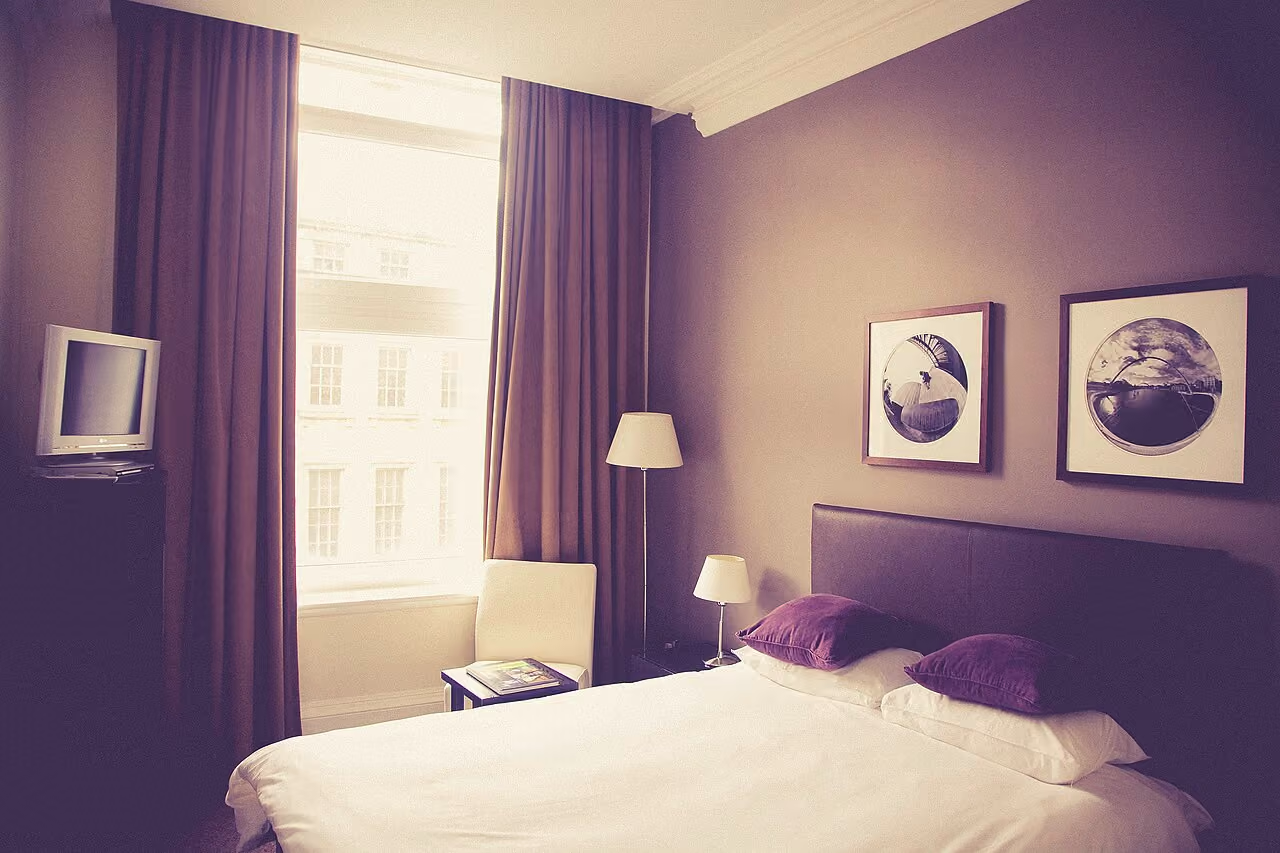
Plum-gray, muted rose and soft ivory can give the room depth without making every surface dark. A darker bed wall may feel reassuring, while lighter storage fronts make clothing easier to find when the resident wakes. Test samples under the lights actually used after a shift. Color photographs taken in abundant daylight are a poor guide to how the room will feel with curtains drawn in the morning.
Keep patterns and visible objects selective. Work clothing, clocks and charging equipment can dominate the view from the pillow if they have no planned home. Closed storage is useful here, but it should remain easy to operate quietly. Bedding needs to suit the person’s comfort and care preferences rather than a romantic idea of cocooning. Provide adjustable layers if the resident prefers them, and leave the bed straightforward to make. A room used for unusual hours still needs ordinary cleaning and airing routines that the household can maintain.
Spend on performance before atmosphere
The most important purchase may be the window treatment rather than a new bed frame or decorative wall finish. Compare products by the complete installed performance and the supplier’s information, not simply by how dark the sample looks. A more expensive treatment is worthwhile only if it resolves a real problem. Keep access to tracks and hardware for adjustment and repair, and check how the fabric is cleaned before ordering a large quantity.
Agree on a cleaning time that does not repeatedly interrupt the resident’s sleep. The room still needs ordinary maintenance, but a conventional morning household schedule may be inappropriate here. Keep spare clean bedding accessible outside the sleeping zone if that helps other residents prepare it without entering. Small organizational decisions can protect the practical benefit of the larger design work.
Try a safe temporary light-control test where possible, without interfering with ventilation, window operation or heat sources. Assess the room during the intended sleep hours and record the remaining problems. This proposal is unsuitable when unresolved heat, ventilation or serious noise makes the room inappropriate for rest; decorative changes should not disguise that condition. The final checklist is specific: effective light control, usable air and temperature arrangements, a short arrival routine, reachable lighting and household cooperation. In an imagined morning, the resident returns while the street is waking. The room does not pretend it is nighttime outside. It simply offers a prepared, considerate place to withdraw from the day.
Check, record, then decide.
A proposed worksheet for your own observations. Use consistent units for dimensions and keep the conditions with each record.
Actual sleep-hour light
Where to check At the pillow and window during the intended daytime sleeping period.
- Record
- Log time, weather, treatment position and visible gaps above, below and beside it; compare the same views with an approved temporary trial.
- Read the result
- Fabric darkness alone cannot establish useful room light control when installation edges remain bright.
- If it does not work
- Resolve the complete treatment with a suitable supplier rather than repainting the bedroom darker.
Arrival and household overlap
Where to check Along the returning worker's route and in rooms active beside the bedroom.
- Record
- Write arrival actions, nearby laundry or call times and repeated door activity; distinguish an avoidable household routine from outside noise.
- Read the result
- A shorter arrival sequence and agreed timing may address disturbance that decorative acoustic-looking products do not.
- If it does not work
- Relocate noisy tasks or seek a building-specific assessment for a substantial unresolved sound problem.
Closed-room comfort
Where to check In the bedroom with the treatment arranged as it would be during sleep.
- Record
- Note perceived heat, airflow, existing vent locations and window operation; if using a thermometer, record device, unit, time and conditions rather than a universal target.
- Read the result
- Light control must not depend on obstructing necessary ventilation or ignoring an uncomfortable room.
- If it does not work
- Have the environmental problem assessed and revise the treatment or sleeping arrangement appropriately.
A practical trial
- Observe the room during the actual sleep period, including the household's normal activities rather than an unusually quiet day.
- Move work belongings to their proposed landing place and rehearse settling without the brightest ceiling setting.
- Agree a workable cleaning and bedding-change time that does not repeatedly interrupt the shifted sleep schedule.
Compare the same scope
- A complete suitable room-darkening treatment and its operating hardware
- Focused arrival-light and storage changes
- Separate scope for serious noise or ventilation problems
Cost drivers to discuss: Fabric, lining, track and installation details; Reachable lighting and any qualified electrical alteration; Technical investigation beyond a decorative room refresh.
Choose another route when: Do not present decor as sufficient when heat, ventilation or serious noise remains inappropriate for the person's intended rest.
The download is a blank record template. Your completed notes remain wherever you choose to keep them; this page has no measurement-submission service.
Sources for this guide
Each reference’s supported point and limits appear beside the relevant passage above. Product documentation applies to the named product, rather than every similar item or the photographed room.
Source text checked November 4, 2026. Specifications can change; confirm the current instructions for the exact item before ordering.
Your questions, considered.
Why test a shift-worker bedroom during the day?
Daytime light, warmth and household activity can differ substantially from nighttime conditions. Evaluate the room during the intended sleep period so improvements address the actual environment rather than an evening impression.
Is dark paint enough for daytime sleeping?
No. Dark walls do not resolve light leaking around a treatment, disruptive household routines or unsuitable heat and ventilation. Prioritize those conditions before a decorative wall or bed-frame change.
Can curtains soundproof a room for a shift worker?
Curtains may soften some reflections but should not be treated as sound isolation. Significant noise can require a building-specific assessment, while household routines may need changes alongside the room design.
About this guide: written with AI assistance for TIANLICHUJU. These are general design ideas, not a measured survey or a completed client project. Any domestic vignette is fictional. Confirm product specifications, site dimensions and local requirements before construction; use qualified professionals for regulated work. Read our editorial approach or suggest a correction.